Saturday, 11 November 2017

Vietnam Part 4: Sapa

It is beautiful here at this time of year.  I think you have come at the best time of year.

Our guide informed us that within a few weeks the rice fields would be harvested and the valley would look very different.  Although some parts of Vietnam are able to get two, or even three, harvests in a year, because Sapa is quite high in the mountains and gets quite cold during winter, the locals are only able to get one harvest per year here. 


Sapa is located about 400km north-west of Hanoi, at an elevation of approximately 1,600 m on the slopes of the Hoang Lien Mountains.  It is this higher elevation and cooler climate that has made it an attractive summer time retreat.  But it is also the mountains and rice paddies and various colourful ethnic groups that live here that are attracting tourists to this area.  Search the internet for 'Sapa trekking', and you will find lots of tour companies offering trips and lots of bloggers talking about their experience.

For most travellers the biggest decision to be made is whether to stay in a hotel and use that as a base for day hikes, or venture a little further and do a home-stay. We decided to go with the home-say option.  Bron was a bit hesitant about how much she would have to carry, which actually ended up not being much, but we both agreed that a longer hike into the valley and a bit further away from Sapa town was definitely the way we wanted to experience this area.  We also found it really useful reading about other peoples experiences of home-stays, and the warm hospitality that this area is well known for.  And so we trawled the internet looking for trekking options until we came across the one that sounded perfect for us. 


Day 1 of hiking, and some of the ladies from one of the local villages that joined us for the walk from Sapa town to their village.


This photo does not do the various shades of green and yellow justice.


Our ever-smiling tour guide and Bron enjoying a short rest break

There are two main ways of getting from Hanoi to Sapa.  Either by bus (about 4 to 5 hours) or by train (about 8 hours).  We decided to travel there and back by over-night train.  Not only would we be saving on accommodation costs, but we would also be avoiding any potentially crazy bus driving (we had experienced enough of this in South America). 

We opted for a shared carriage and ended up sharing with a great couple from London that were also heading to Sapa for a few days of trekking.  Actually, it seemed that just about everybody on the train was doing this trip for the same reason.  

On arriving in Sapa we were taken to our hotel, where we would be staying the second night, and had some time to have a shower and get some breakfast before the full day ahead.  We were also able to leave our main bag backpack at the hotel, and each carried a small day bag.  After breakfast we met our guide, and the other members of our trekking group, and headed off into the valley.


Rice paddies everywhere


Passing a home with some corn left out to dry on the front porch


More rice paddies


Although September is approaching the end of the rainy season, the average rainfall in Sapa at this time of year is still around 180 mm for the month.  And so we weren't surprised when we did have a few showers while we were there. What we hadn't been expecting though was the muddy trails.  Luckily we had decided to pack our waterproof hiking boots, and so the mud wasn't a problem.  What did surprise me though was what some other people decided to trek in.  Our group all had decent shoes, but we passed some people that were doing this hike in flip flops (or thongs if you are from Australia, slops for the South Africans, and jandals for the Kiwis).  Needless to say, they didn't look like they were having fun. 

Our trek included lunch in a small village, some souvenir shopping from the ladies that had joined us for our walk (hmmm.... so it wasn't just a coincidence that we walked down together), and then late afternoon we arrived at our home stay.


The view from our home stay (above) and Bron standing outside our home stay (below)


As we still had some time to spare before it would get dark, and because we were all feeling quite hot after a good day of walking, we decided to head down to the river for a swim.  We had seen a few kids swimming in the river on our walk and it looked like a great way to end the day.  What we hadn't realised was just how cold the water was going to be.  This river was coming down from the Fansipan Mountains, which have an elevation of about 3000 m, and the water was freezing.  While there was a lot of dangling of legs in the river, none of us actually had the courage to go for a fully submerged swim.  I'm telling myself it also has something to do with the strong current at the section of river where we were sitting.  

Soon it was time to head back to the home stay for a hot shower and a cold beer.  It might be a fairly rural area, but the houses here do have electricity and the owners go out of their way to make it as comfortable as possible for the tourists that are coming through.  Then it was time for dinner.  We sat down with our host family for a feast, washed down with home made rice wine.  


The last of the revelers still enjoying some rice wine after dinner (above) and our sleeping area (below) 


The next day we had another fantastic meal - pancakes and fruit - and then headed off for the next part of our trek.  If we thought the previous day had included some muddy sections, we hadn't seen anything yet!


A seriously muddy path through a bamboo forest (below)


We also saw a number of water buffalo.  Coming from South Africa, when I think of buffalo I think of wild animals that need to be treated with respect.  Keep your distance and watch those horns. But these water buffalo are domesticated and play an important role as far as the local farms are concerned.  They are used to plough the fields and once the field has been harvested, are sent in to graze on the stalks. It is amazing watching them walk through the rice paddies.  At this time of year, those fields that have been harvested are essentially fields of mud.  The water buffalo, which probably weighs around 500 kg, sinks down a fair way into the mud. But this isn't a problem. The water buffalo is extremely strong and carries on as if the mud wasn't even there.  


Water buffalo munching on stalks (above) and being ridden by the local children (below)


Water buffalo just doing their thing (above) and
a close-up of two water buffalo in their overnight pen (below).


At the end of day 2 we arrived back in Sapa town.  As with Halong Bay, we found that most people seem to stay just the one night in Sapa, and so the rest of our group headed off to catch the train or bus back to Hanoi. We had however decided to stay 2 nights, with our second night being in a hotel in the town. 

One thing that you can't miss in Sapa is the amount of construction that is underway.  And it all seems to be focused on building more hotels and accommodation.  There is clearly an expectation that tourism is on the up here.  


Sapa town, above and below.


The next day we headed off on another trek.  This time towards the Cat Cat village.  This walk was along paved paths, and had clearly been set up with the tourist in mind. There were lots of little stalls selling curios on the way, and in Cat Cat village the main attraction was a theatre where the locals showcase traditional clothes and dancing from this region.  


Passing curio stalls on the way down to Cat Cat village (above) and
 a field of purple flowers (below)


Some pictures taken around Cat Cat village


Showcasing traditional clothes and dancing in the small theatre in Cat Cat village (above)


After walking down to Cat Cat village, there is the option of walking back up, or catching a lift.  We caught a lift and arrived back at our hotel at around 14:00.  This meant that we still had some time to spare as our transport to the train station was only leaving at around 18:00.  We decided to head off to Fansipan Mountain with some friends that we had during the day.  

The Fansipan Mountain summit is situated at 3,143 m above sea level, and is the highest peak in Indochina.  For those wanting to know which countries are part of Indochina, here is a Wikipedia link:  https://en.wikipedia.org/wiki/Indochina

Nowadays the easiest way to get to the summit is by cable car.  With all the cloud around, we didn't fancy our chances of seeing much from the top, but decided to go anyway. 


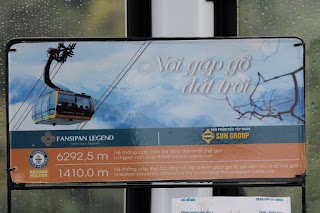
This sign says that this is the longest non-stop three-rope cable car (6292.5m) and also has the greatest change in elevation by a non-stop three-roped cable car (1410.0m)


At the top!


After our trip to the top of Fansipan Mountain, it was time to head back to our hotel and start getting ready for the train ride back to Hanoi.  We had a great time in Sapa, and highly recommend it if you get the chance.

Next up:  Hoi An (not to be confused with Hanoi!)

Saturday, 4 November 2017

Vietnam Part 3: Halong Bay

Halong Bay is considered one of the must-see destinations in Northern Vietnam.  But there are various articles on the internet suggesting that this is a 'tourist-trap' that is best avoided, and that tourism is actually contributing to the ruin of this ecological gem!  It is a complex issue and no one blog or article is going to uncover all the answers.  This is just a few observations from our time visiting Halong Bay.

But first, for those that are asking, 'what is Halong Bay?'

Halong Bay is a World Heritage Site situated on the Northern Vietnamese coast about 150km from the Chinese border.   The main attraction here is the limestone pinnacles and islands that fill the bay.  Depending on who you ask, the number of pinnacles and islands varies from about 1,500 to about 4,000.  I don't think it matters which number is correct, there are a lot of them!

A trip to Halong Bay, for most tourists, starts in Hanoi, and consists of a four hour drive before embarking on a tour of the bay by boat.  Some people will do this trip in a day, which I think means 4 hours on the road, 4 hours on the water, and then another 4 hours on the road.  This does not sound like a relaxing day out, and I would recommend avoiding this option if you can.

The next option, which seems to be the most popular, is to spend a night on-board the boat.  This means that you have a half day either side to enjoy some time in Halong Bay.

The option that we went for, and which I think gives a better overview of Halong Bay, is to spend two nights on the boat, and to have the extra day to explore some of the quieter parts of Halong Bay.


The view from our boat, from the harbour, out towards Halong Bay


Heading out to one of the anchorage areas within Halong Bay


After boarding the boat and being shown to our rooms, it took about two hours to get from the harbour to the location where we would be anchored for the night.  We were told that there are three locations within Halong Bay where boats can drop anchor for the night, and that each boat needs to reserve its spot ahead of time.  Whilst this means that you can forget about your boat heading off to some secluded spot, it does have a few other benefits:

  • The lights of the surrounding boats at night can be quite pretty; and
  • From a practical point of view, it means that it is easier to control litter and any potential pollution as it is generally confined to these three locations. 

And so we headed out through the limestone pinnacles towards the spot where we would be spending the night along with a flotilla of other tourist boats.  After arriving at our destination, the afternoon's activities included kayaking and a visit to Ti Top Island.  This kayaking / Ti Top island combo seems to be the popular choice for a lot of the boats.

For the kayaking we were taken to Luon Cave.  After paddling through a short cave you arrive in a small bay completely surrounded by high limestone rock.  The only way in and out of this bay is through the cave, and because of the high surrounding rock, it is completely protected from any wind.  This makes it the ideal spot for kayaking, even if it is your first time.  But if this isn't enough to entice you on to the water, another option is to take a ride on a bamboo boat which is rowed by a local.

After the kayaking it was off to Ti Top Island.  Ti Top Island is named after the Russian Cosmonaut Gherman Titop, who visited this island in 1962.  But the reason for visiting Ti Top Island is the view from the top.  There is also a small beach at Ti Top Island for those looking to have a swim.  Unfortunately though Ti Top Island is right next to one of the anchorage areas, and the water is not clean.  So it's not a great spot for swimming, but if the tide is low enough it is a great spot to just sit on the beach and enjoy an ice-cream.


View from Ti Top Island, above and below


Green bean and cereal ice-cream.  Actually much tastier than it sounds!

Then it was back to the boat to enjoy sunset, and start getting ready for dinner.  Whilst I can't vouch for the other tour boats, the meals that we had on our boat were fantastic. Dinner on the first night consisted of about 6 or 7 different courses, all extremely tasty!  


The next day we said goodbye to our fellow passengers, as we were the only ones staying a second night, and headed to Ti Top Island to meet up with our tour group for the day.  Our tour group for the day consisted of several other travellers from various boats that had also signed up for 2 or more nights.  After our group had assembled we were taken out by boat to explore some of the quieter parts of Halong Bay.  Our day out exploring included more kayaking, a visit to a cave, a short break to enjoy a swim, and a visit to a pearl farm.  It was great to see the other side of Halong Bay, where the water is cleaner, the bay is quieter, and the experience is even more relaxing.


After our day out we were reunited with the Phoenix Cruiser, our boat that we were staying on, and a new group of passengers that had been picked up earlier in the day.  Once again we ended the day with sun-downers on the deck and another excellent meal.

Our final day in Halong Bay included a trip to Hang Sung Sot (Surprise Cave) and a lesson in making spring rolls.  The spring roll making lesson was really just about rolling raw spring rolls with a filling that had been pre-made and leaving the frying of the spring rolls to the chef. But the visit to Hang Sung Sot was fantastic.

My expectations for the spring roll making lessons included having a full hands-on experience.  Because we were only taking part in one small part of the spring roll making process, it felt a bit like we had been cheated out of the full experience.

However, if my expectations for visiting Hang Sung Sot were to simply to see another limestone cave, these expectations were blown away.  Firstly it is the size of the cave that is awesome.  It really is big. The main cavern is high and long, and just when you think you have reached the back, you realise that around the corner it still has more to offer.  And then there is the fantastic lighting  throughout the cave.  Whilst some might say that the lighting is 'artificial' or 'fake', the reality is that you wouldn't see much if the cave wasn't lit.  Yes the different coloured lights might seem a bit overdone, but it actually makes the cave feel alive and gives a great atmosphere.


Hang Sung Sot (Surprise Cave)


The main cavern, Hang Sung Sot


View from Hang Sung Sot


Heading back to the harbour


A mostly peaceful video clip of Halong Bay, interrupted only by a couple speed boats

I think that your experience of Halong Bay is what you make of it.

If you come out here hoping to fit as much as possible into a short period of time, you might be disappointed.

If you come out here expecting to see only pristine beauty and clean water, you might be disappointed.

If however you come out here with a bit of extra time to spare, realising that some small parts of Halong Bay have been impacted by tourism, but that there is a much larger area that is beautiful and untouched, you might just be surprised.  The irony of course is that those that complain about Halong Bay being a tourist trap and a site that is being destroyed by the impacts of tourism, are probably those that are only seeing the small part of Halong Bay where tourism is being concentrated to ensure that the larger area is not negatively impacted by tourism.

Next up: Sapa

Saturday, 28 October 2017

Vietnam Part 2: Perfume Pagoda

We were picked up from our hotel at around 8 am by our tour bus, and after a tour around Hanoi to pick up our fellow day-trippers, we headed off to Perfume Pagoda. Our tour group was relatively small, just 12 people, and we had a great time hearing where people had already been in Vietnam or were still planning on going.  Our guide was also really rad, super friendly and organised. The Vietnamese name their children after qualities they wish them to posses. The name of our guide on this day translated to Mr Hero. In Halong Bay we had Mr Millionaire.

Perfume Pagoda is about 70 km south of Hanoi, or about an hour and a half drive.  Its not that people choose to drive slowly here, its just that with the traffic and pot holes and trucks, you don't really seem to travel anywhere too fast in Vietnam.  On the way we stopped at a marble / textile / snack shop.  There were quite a few tourist buses stopping here, and this was an obvious tourist trap, but at no point did we feel pressured to buy anything, and it was a good chance to stock up on water and snacks for the rest of the day.

Perfume Pagoda is a complex of around 30 Buddhist shrines, of which we would be visiting two.  On this trip to Perfume Pagoda, the final two kilometers are by boat along the Suoi Yen River.  The little boats that take tourists up the river are mainly the non-motorised type, and mostly the paddling is done by local women.  Apparently there is not enough demand for year-round trips to Perfume Pagoda, and so the men generally head to the cities to find work, whilst the women stay behind to look after the house, the kids, and earn a bit of extra money by taking tourists up the river.


The first temple that we visited was Thien Tru Pagoda  or the Heavenly Kitchen Pagoda.  As you can see from the photos below, there were not too many other visitors.  Apparently it can be a completely different story if you are visiting during the first three months of the Vietnamese New Year, which is based on the lunar calendar and normally starts in either January of February.  During the first three months of the Vietnamese New Year, Buddhist pilgrims will travel to Perfume Pagoda to pray for happiness and prosperity for the year ahead.  Apparently on some days the number of people travelling to Perfume Pagoda can be in the thousands.  I'm glad we were there during the quiet part of the year!


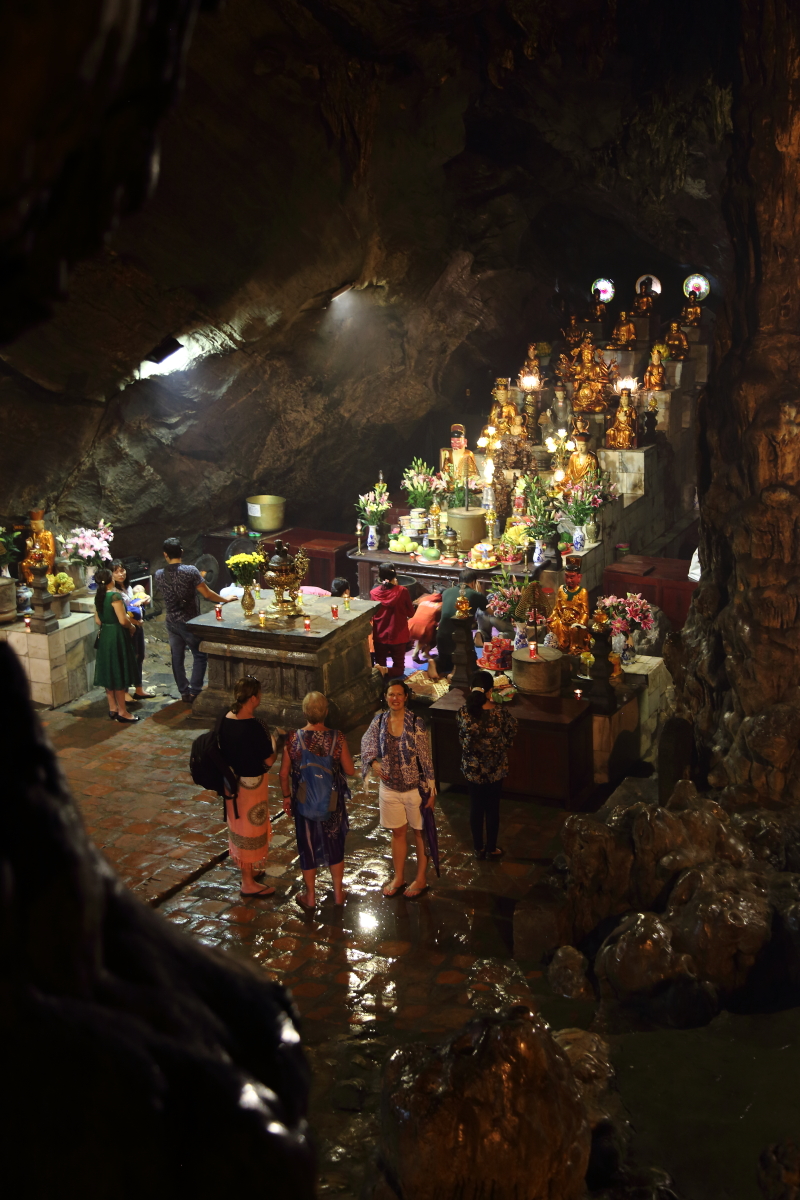
After having visited Thien Tru Pagoda, we then headed by cable car up to Huong Tich Cave to visit Chua Trong or the Inner Temple.


Then at the end of the day it was back on the boat, and then back on the tour bus for the drive back to Hanoi.


Next time: Halong Bay