Friday, 30 May 2014

The land of volcanoes and canyons

How impossible would it have been for us to be in Peru for a few weeks again and not book a short trip away? The only hard part about that decision was choosing where to go! Since we had already been to Cusco and Machu Picchu our next top choices were Arequipa or the jungle. This time Arequipa and the Colca canyon won but we still plan on going to the jungle sometime.


Arequipa is the second largest city in Peru after Lima with a population of about 1 million people. In the heart of the Peruvian Andes, Arequipa is ~2400 m above sea level and lies at the feet of three majestic volcanoes: the mighty Misti, the snow-capped Chachani, and the serrated PichuPichu. The historic city centre was largely built using sillar or ashlar, a white volcanic rock, earning it the nickname of ‘the white city’. The rich mix of indigenous and colonial Spanish cultures, building techniques and characteristics of the historic city centre has earned Arequipa status as a UNESCO World Heritage Site.


Around the Plaza de Armas at sunset


Arequipa Cathedral at Plaza de Armas


...and at sunset


We arrived in Arequipa to a beautiful clear sunny day early on Friday morning and got started with exploring straight away! Our first tour was an open-top bus tour of some sights in the countryside and on the outskirts of the city. We visited a beautiful old mill in the countryside which is still functional and uses hydro-energy to power the mill for grinding corn to flour, the Mansion de Fundador dating from the beginning of the Spanish occupation, and viewpoints with awesome unobstructed views of the 3 volcanoes.


The mighty Misti volcano


Amazing views of Chachani on the left and Misti on the right


Up close with a friendly alpaca


The second tour for the day was a walking tour of the historical city centre. Our local guide was very knowledgeable and took us around the local fresh produce market, the Jesuit church, down interesting streets we wouldn’t have discovered on our own, and to the Santa Catalina Convent. Founded in 1580, the Monasterio de Santa Catalina covers a whole block and is like a self-contained city. It is obligatory to take a guided tour and just as well since it is easy to get lost in the narrow winding streets. We really enjoyed visiting the convent, the colourful narrow streets and the architecture. It’s a pity we were on the last tour of the day though; our tour guide was clearly trying to get us out in record time which was a real shame.


Monasterio Santa Catalina


Streets of Arequipa


...at sunset


There wasn’t much time for lunch inbetween our tours so we were quite ravenous by dinner time, the perfect reason to try out a popular local Peruvian restaurant. We really enjoyed our dinner at Zingaro in its sillar building with typical arched ceiling. Justin tried the traditional spicy stuffed peppers called ‘rocoto relleno’ followed by the alpaca stroganoff while Bron had the mint and bacon stuffed trout with a berry sauce, yummy! We were looking forward to tasting more of the local cuisine over the next few days.

Our two-day Colca Canyon tour started early on Saturday morning when we were collected by our lovely guide Mari Luz and confident driver Francisco. The route to our destination of Chivay was very scenic and interesting with constantly changing landscapes all the way. We found Arequipa to be a very dry city, a theme which continued to Chivay. This is surprising since the province of Arequipa is an important agricultural area in Peru. There were many stops on the way to Chivay to appreciate the desolate landscape dotted with volcanoes, to admire the herds of vicuñas, llamas and alpacas, and to try coca tea mixed with other (legal) local herbs. The highest point reached on the journey was 4910 m above sea level while the volcanoes towered above at more than 6000 m.


Scenery on the way to Chivay. Just for you Bren: a cement factory! 
Curiously the same company also makes dairy products...


Vicuña crossing


The mighty Misti with a fresh spring in the foreground


Gamboling vicuñas


Alpacas and llamas at a spring


Tony and one of his alpacas


Watch our for alpacas crossing the road! 


Interesting vegetation at + 4000 m


At the coca tea rest stop. Don't wander off too far, you don't want to be left behind in the middle of no where!


At the highest point for the weekend: 4910 m


A local wearing traditional dress at a viewpoint overlooking Chivay


We reached our destination of Chivay by lunch time. With a population of 5000, Chivay is the largest town in the Colca Canyon region and has managed to embrace tourism without abandoning its traditional ways. At 3650 m we could feel the effects of the altitude catching up with us, surprisingly though, we felt better than during our Cusco trip in November. After checking in at our hotel, we were shuttled to the local hot springs where we enjoyed a soak in the hot pool surrounded by steep cliffs and valleys. However, we have definitely been spoilt by our experience at the Termas Geometricas in Chile, hot springs will never be the same again! In the evening we joined the Belgian couple on our tour for dinner and some traditional music and dancing performed by enthusiastic locals. Justin was a good sport when he was called upon to join the fun donning a traditional skirt, hat and cape and twirling the impossibly short dancer around.


Justin being a good sport at the traditional dance evening 


Sunday saw an even earlier start with a 06:00 pick up time. Today was the day for Condor gazing! But first: a terribly bumpy ride down into the canyon with visions of the mini-van plummeting over the precipice at any moment. At its deepest point Colca Canyon is 4160 m deep, twice as deep as the Grand Canyon in the US and one of the deepest canyons in the world. We stopped at many viewpoints along the way to Cruz del Condor to admire the canyon with its hundreds of agricultural terraces. We were in awe of the beauty of the canyon and the ability of the people tame this wild landscape enough for farming.


Panoramic view of the Colca Canyon


Boibs at Colca


There were plenty of the long fingers-in-the-air cactuses around Colca


Cruz del Condor, Condor Cross, is a popular tourist destination for viewing the majestic Andean Condors. At 1-1.3 m in length and with a wingspan of 3 m, the Andean Condor is the largest flying land bird and one of the largest birds in the world. Weighing between 11 and 15 kg, these mighty birds prefer to live where they can make use of air currents to glide with ease. Young birds up to 9 years of age have brown feathers whereas adults have black plumage with a distinctive white collar and a white stripe on the wings. Females are smaller and males have a crest of skin on the head. Condors have become endangered due to hunting and decreasing habitat and have come under conservation efforts, however, these are slow since the birds take 9 years to mature, breed only once every few years, and only raise one chick at a time.

Around 500 Condors live in the Colca Canyon and we were privileged to see a handful using the thermal currents to fly. We saw both young and adult birds flying in the canyon, however none were circling really high above. They were a pleasure to watch though; they appear to glide so effortlessly. Two of the younger birds landed on a rock really close to the view point, we were really fortunate to see them so close up and watch them being affectionate for a while.


The canyon at Cruz del Condor
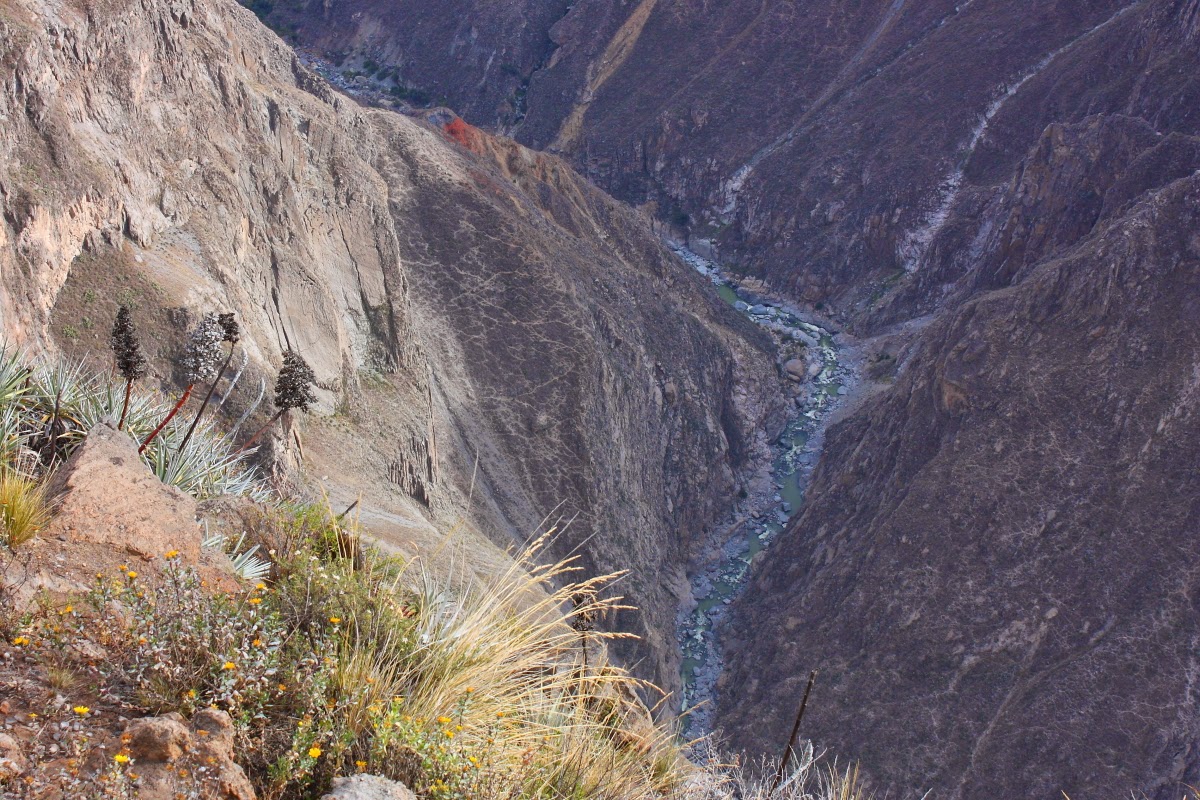

Looking down the canyon to the river Colca


Condors coming in to land


Young condors resting and being affectionate 


Our lovely guide Mari Luz tempting us with a tart cactus pear on the way back to Chivay
(yes, a cactus pear is different to a prickly pear)


On the drive back to Arequipa


From Cruz del Condor, we made our way back to Chivay on the same rocky road. After lunch it was time for the long drive back to Arequipa. After a morning of bumpy and winding roads, Bron was not a happy camper and threatening a bout of motion sickness but fortunately made it back to Arequipa with no incidents. After a full weekend a relaxed evening was in order.

Unfortunately, the altitude had taken its toll and while Justin was fortunately unaffected, Bron came down with an unpleasant stomach bug on Sunday night. This ruled her out from the planned Monday activities of river rafting on Rio Chili. It was a slow recovery day for her at the hotel while Justin had a really enjoyable river rafting trip. By Tuesday she was feeling better and ready to make the most of the last few hours in Arequipa before heading back to Lima. Thank you amazing husband for looking after me and fetching supplies!

For our last morning we had planned to visit the Museo Santuarios, home to Jaunita the ice maiden. Discovered in 1995 on Mount Ampato by anthropologist Johan Reinhardt, Juanita was a 12 year old girl sacrificed by the Inca high priests 550 years ago. Considered one of the world’s best well-preserved mummies, Juanita has provided amazing insight into the Inca culture thought to be long lost. Our visit started with a movie describing Juanita’s discovery and some thoughts on the moment of her death. Juanita herself is on display in a glass freezer as is the blanket she was found wrapped in and many of the items found buried with her, offerings to the gods and things she would need in the afterlife. Also on display is information and artefacts of other sacrificed children found since the discovery of Juanita. Chosen at birth from noble families and raised apart as special, it was an honour for their families, and these children believed they were going to join the gods. Contemplating the idea of human sacrifices aside, the visit to this museum was very interesting and definitely worth it if you are in the area.

The final stop for this trip was Mundo Alpaca or Alpaca World. From live animals to the finished product, Mundo Alpaca is a tribute to the wool industry of the Andes. We enjoyed the room full of vicuña, guanaco, alpaca and llama pre-processed wool, the exhibit of traditional weaving, and the museum of wool machinery from the initial sorter to the loom. If you are a knitter you will love the wholesale wool warehouse. Every colour imagineable available in those big old school wool skeins, too awesome! Unfortunately Bron was limited by weight and had a hard time choosing only a few standard balls of baby alpaca wool. New to knitting, it’s probably a good idea if she gets some practice in first. This store is a must for knitters and wool lovers!

After lunch it was time to head to the airport and make our way back to Lima =( Long weekends go by way too quick no matter how long they are!

We had a really great weekend away and thoroughly enjoyed our time in Arequipa and the Colca Canyon. A big thank you to Mari Luz and Francisco from Colonial Tours and everyone on our tour, we had such a nice group of people for the two-day trip and it really made the difference. Also, thank you to Maurice from www.cuscoperu.nl for arranging everything for our custom-built tour. We highly recommend him if you are planning a trip to Peru!

Until next time

x

Thursday, 22 May 2014

Marph goes to Arequipa!

This past weekend we did a 5 day trip to Arequipa: volcano and canyon country! 


The beautiful snow-capped Chachani volcano in Arequipa.

Our trip included a 2 day tour to the Colca Canyon:


We enjoyed the scenery on the way...


...and all the llamas, alpacas and vicunas freely roaming about. 


The highest point we reached was 4910 m! Sjo, it was hard to breathe up there!


We spent the night in Chivay in the picturesque Colca Canyon. 


We were up very early the next morning to descend into the canyon and to see the majestic condors fly on the thermals. It was cold so I borrowed a scarf! 


We also stopped in some of the small towns on the way back to Chivay, like the one with this small quaint church.


Back in Arequipa we enjoyed exploring the city and seeing the sights such as the Plaza de Armas, 


the Santa Catalina Convent, 


And the Museo Santuarios Andinos where Juanita, the ice maiden, is on display. 


We also enjoyed trying some of the local food like this queso helado (directly translated it means 'cheese ice-cream' but it actually tastes like milk tart filling, yummy!), 


and alpaca meat and these hot stuffed peppers called rocoto relleno. 


We learnt a lot about the 4 different camelids found in the Andes, prized for their soft and warm fibres: the vicuna, the guanaco, alpacas and llamas. My favourite is the Alpaca Suri, aka Rasta Alpaca!

More about our adventures in Arequipa and Colca to follow soon! 

Wednesday, 7 May 2014

Her name is Rio

… and she dances on the sand
Just like that river twisting through a dusty land
And when she shines she really shows you all she can
Oh Rio, Rio dance across the Rio Grande
(Rio, Duran Duran)

After 9 months in Brazil we finally made it to Rio de Janeiro! For four days over the Easter weekend we were walking on famous white sand beaches, gazing up at mountains, eating churrascaria, and dreaming of dancing the night away. If you think New York City never sleeps, you need to visit Rio!

We arrived in Rio at midday on Good Friday and with such little time in the city, it was time to get going. First stop: the beach! Copacabana here we come! Copacabana, Ipanema and Leblon are neighbourhoods in the South Zone of the city and are famous for their pristine white sand beaches. During our stay we would walk the length of all 3 beach promenades, about 8 km, and some parts more than once. We loved all the palm trees lining the length of the beaches and the black and white geometric wave pattern of the tiles of the promenade, it reminded us so much of Portugal. Although practically next to each other, the beaches can be quite different. Denoted by the number of the nearest post, some sections of the beach are more family oriented, some have a more relaxed atmosphere, others are more sophisticated, some you go to see and be seen, there is a gay section as well as sport oriented sections for football, volleyball and footvolley. Everywhere on the beach it is easy to rent an umbrella and chairs or buy a beer and agua de coco or a sarong and sun block. Our favourite was the Ipanema stretch of beach between posts 7 and 9.


View of Sugar Loaf Mountain coming in to land


Copa, Copacabana!
Looking toward Sugar Loaf


Looking back on the length of Copacabana beach


Palm tree at Ipanema


Once we reached the end of Copacabana underneath Sugar Loaf, we caught a taxi to Praia Vermelha and joined the long queue for the cable car up the mountain. From this point on, it would be the weekend of the long queues! For every attraction, we stood in queues for at least an hour. After 90 minutes we finally had tickets and continued in the queue for the actual cable car.

Sugar Loaf is 396 m high and the cable car to reach the top is in two stages. The stop over point is Urca Mountain at 224 m high. At Urca we enjoyed the first views over the bay and the antics of cheeky monkeys in the trees while queuing for the cable car to the summit. It had been a beautiful clear hot day and we were looking forward to sunset at the top. However, while we were at Urca, the clouds started rolling in. At first there were just a few fluffy clouds that added atmosphere in the pastel sky. But by the time we were on Sugar Loaf it was completely clouded over and quite misty. We still enjoyed our time at the top and after some time the mist passed over revealing a lit up Copacabana and Flamengo beach and a lit up Statue of Christ peering over the clouds. Most of the city remained cloudy but we still enjoyed the views. We consoled ourselves that the best views of Rio were still to come at the top of Corcovado.


Waiting for the cable car at Sugar Loaf


Boibs at Sugar Loaf


Cheeky monkey!


Cloudy sunset over Rio


The next day we were up bright and early and headed off to join the queue for going up Corcovado to the Statue of Christ. We were finally near the front after 90 minutes of patiently queuing when they stopped ticket sales due to traffic at the top of the mountain. None of the park officials present could explain in English but thankfully a kind person in the crowd translated. Apparently ticket sales would resume at 17:00. After a moment of grumping about the situation we decided not to waste the beautiful clear day and headed off for some seeing some sights of the city instead.

We caught a metro to Lapa area near the centre for some exploring. The main sights we were looking for were the Metropolitan Cathedral, the Arches of Lapa and the Selaron Steps. The Cathedral has an interesting conical shape but was unfortunately not open when we were there; it must be more interesting inside with the beautiful stained-glass windows than the concrete façade outside. The Arches of Lapa is an aqueduct completed in 1750 with the purpose of bringing fresh water from the Carioca River to the city. The Selaron Steps were an ordinary street of steps transformed by Chilean-born artist Jorge Selaron. He lived in the street and started renovating the steps by covering them in tiles of blue, yellow and green. The steps became on obsession for him and eventually the entire street was covered in tiles. The walls on either side have also been tiled, mostly in red though. It was definitely worth coming to see the steps, something unique. At night Lapa transforms itself from suspicious day venue to the nightlife hotspot; it is well known that the best Samba clubs are in Lapa. Despite our best intentions we didn’t make it for a night out dancing. After full hot days we were just too smashed in the evenings. We must be getting old!


Flower market at Largo do Machado


Teatro Municipal


The Metropolitan Cathedral


Arcos de Lapa


The arches of the aquaduct are undergoing some restorative work


Selaron Steps


Boibs at Selaron


From Lapa we made our way to the Botanical Gardens where we enjoyed the hot afternoon in the cool shade. We enjoyed the palm tree lined avenues, the grove of mango trees, the antics of the monkeys in a quieter part of the garden and the sun-bathing turtles doing yoga-like stretches. From the gardens we made our way to Leblon beach and walked the entire length of the beach until the end of Ipanema. The beach and promenade were really busy in the late afternoon and it was a lovely time of day to enjoy a few hours at the beach.

We loved our weekend in Rio and had a really great time but we were disappointed and surprised at how difficult it was to obtain correct and accurate tourist information considering that Rio is such a tourist hot spot. For example, we asked our hotel reception where the nearest Kopenhagen Chocolate store was. The guy made it sound like a 20-30 minute mission by taxi and metro to the nearest mall and he wasn’t sure if the store would be open due to it being Easter. We decided to leave it. The next day we walked literally 100 m around the corner from the hotel and stumbled on an open Kopenhagen shop. If the hotel doesn’t know what is in their direct neighbourhood, how can they give advice on the rest of the city? This is really unfortunate though as tourists often rely on the hotel to provide the most up to date information. Our hotel’s lack of good information is what resulted in our bad luck for getting to Corcovado. They should have given us all the options and let us choose what we wanted to do rather than deciding for us.


Palm tree avenues in the botanical gardens


Giant lily pads!


Sunbathing yoga turtles


Ipanema at sunset


Caramel popcorn! 


Sunday and our last full day in Rio arrived and with it more determination to get to the top of Corcovado. We were up even earlier and this time we caught a taxi directly to the train station at the base of the mountain. At 07:30, half an hour before opening time, the queue for tickets was already 30 minute deep. We were on the second train up the mountain at 08:20 and already the base of the statue was completely crowded. Unfortunately the cloud of Friday night had returned and while we could observe the Statue of Christ with blue skies behind, the famed views over Rio city were obscured by cloud. It was still very pretty and worth going up but we were disappointed that we had missed out on the stunning views again. We decided to try wait out the cloud but two hours later it was just as thick and we decided to go down.


Statue of Christ at Corcovado


Boibs at the top of Corcovado


Cloudy view over Rio from Corcovado


At the train station we were directed to a bus that would take us back to Ipanema beach. We mostly used taxis and the metro (really affordable, tourist friendly and quite safe) to get around Rio but we highly recommend this bus trip, it was a lovely and inexpensive way to see a large part of suburban southern Rio. The bus felt quite safe too and on this particular route we were confident that we wouldn’t get lost. At Ipanema we wandered around the Sunday Hippie Fair before deciding that it was lunch time. The time had arrived for us to try the churrascaria’s of Rio.

We made our way to Flamengo by metro and had a long walk on the beach promenade enjoying views of Sugar Loaf in search of Porcao Rio’s. We eventually found it, with the help of a taxi driver after walking in the opposite direction. Porcao is one of Rio’s premium churrascaria’s or barbecue style eateries. Beautifully cooked cuts of meat are brought to your table on giant skewers and carved directly onto your plate. There is also a buffet of salads, pasta, bread, cheese and other accompaniments. We took different approaches to the buffet table: Justin enjoyed a selection while Bron focussed on the meat! We really enjoyed our visit to Porcao and look forward to trying different styles of Brazilian churrascaria. We recommend going fall over hungry.


View of Sugar Loaf from Flamengo beach


Meat! Lunch at Porcao


Monday was another cloudy day and we filled our remaining half day in Rio with a walk on the promenade of Lagao Rodrigo de Freitas in the super posh area of Leblon, a final walk on Ipanema beach, taste-testing Kopenhagen chocolates and eating ice-cream. All too soon it was time to head to the airport and back to Vitoria. As a final goobye and token gesture of Rio, it cleared up enough for us to finally have good views over the city from the air as we flew out.


View of the lagoon


We love you Ipanema!


We felt much safer than we expected to in Rio. We were warned by many people to take care in Rio, which we did, our South African-ness brightly shining through. But we didn’t have any trouble or see anything untoward. However, the Tuesday after we left, there was a huge clash with police in a favela in Copacabana, right near our hotel. We didn’t even notice a favela in Copacabana, never mind nearby. Here’s to hoping for a smooth World Cup Rio.

Thanks for a great weekend Rio xxx